riscv-5i
Finished 2026
A 5-stage pipelined RISC-V core in SystemVerilog, checked against the RISCOF compliance suite, running on a Zynq-7000 and taken through a Sky130 layout.
The core
The classic Patterson and Hennessy pipeline: fetch, decode, execute, memory, writeback, with full forwarding, load-use stalling and early resolution of JAL. It implements RV32I and passes all 482 RISCOF compliance tests against Spike.
| Result | Value |
|---|---|
| Compliance | 482 of 482 RISCOF RV32I tests against Spike |
| FPGA | Zynq-7000 on a PYNQ-Z2, 10 MHz, positive slack |
| Resources | 1972 LUTs (3.7%) and 3326 flip-flops |
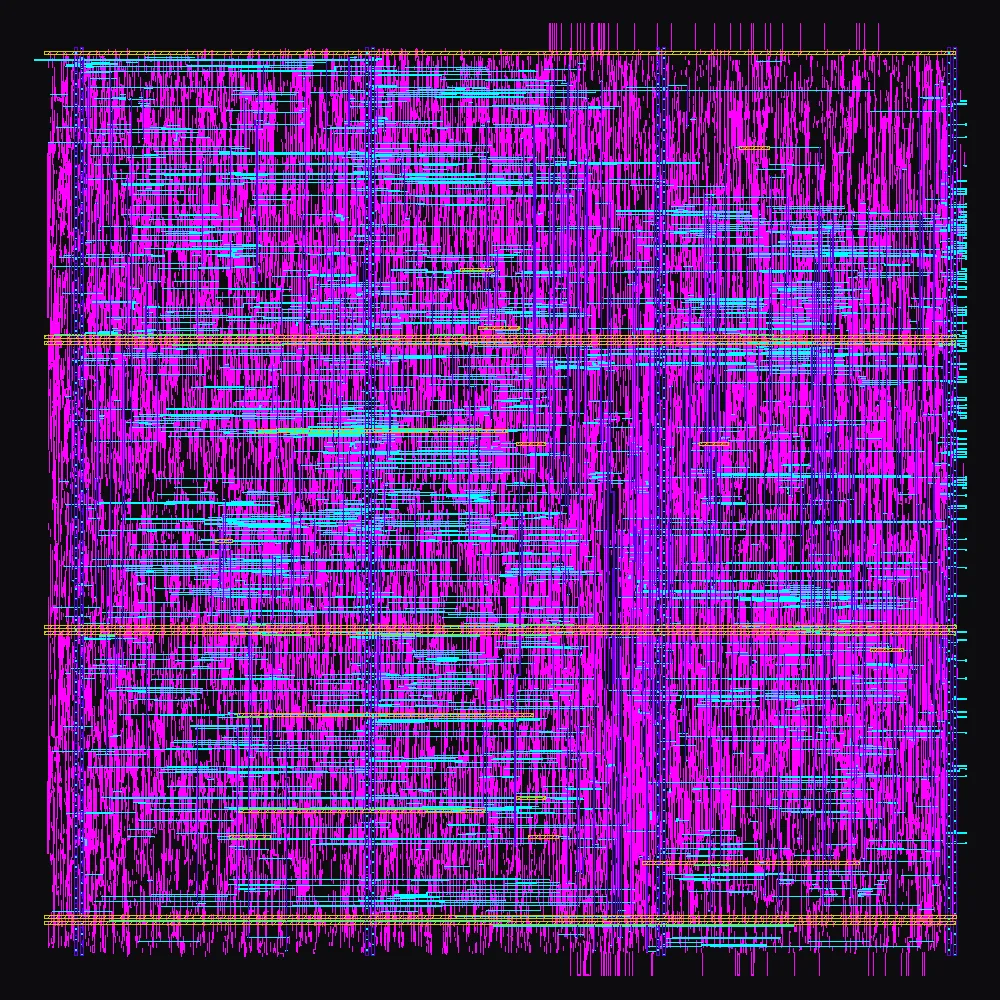
| Sky130 layout | 0.247 mm^2, DRC and LVS clean, 27.8 MHz at every corner |
I scoped it to RV32I and stopped there: no M extension, no CSRs (SYSTEM and FENCE decode as NOPs), no caches, no exceptions or interrupts. Memory is one flat region with a memory-mapped LED register. The Sky130 run is clean on DRC and LVS and closes timing at every corner, but about 4200 max-slew violations are still flagged at the slow corner. They don’t break timing at 36 ns.

Three choices worth a look
- JAL resolves in decode, not execute. Its target is
PC + imm, which is known in decode, so only the instruction already in fetch gets flushed. JALR cannot do this because its target depends on a register. - LUI goes through the ALU. The immediate generator emits the already shifted value and the ALU adds it to zero, so LUI needs no new logic. AUIPC works the same way with the PC on the other input.
- Instruction memory reads combinationally. My first FPGA bring-up used a synchronous block RAM, and branches refused to fire on hardware while RISCOF still passed in simulation. The postmortem in the verification article walks through finding it with an ILA.
The timing diagrams for every hazard case are on the original docs site.
Articles
- ArchitectureThe datapath, the five stages and the design tradeoffs behind them.
- Pipeline stagesWhat each stage does and why the logic looks the way it does, with the RTL.
- Running on the FPGAWhat synthesis cost, where timing closed and the demo running on a PYNQ-Z2.
- VerificationThe RISCOF compliance matrix, the regression set and a branch bug found with a Vivado ILA.
- Unit-level cocotb testbenchesTestbenches for the ALU and the hazard unit, with functional coverage.
- Running the core through Sky130Taking the core through an open source RTL-to-GDSII flow, with timing closed at every corner at 27.8 MHz.
- SetupToolchain install, build and simulation steps.