Architecture overview
The riscv-5i core is a classic Patterson & Hennessy 5-stage RV32I pipeline: instruction fetch, decode, execute, memory access, and writeback, separated by pipeline registers. This page is the overview. Pipeline Stages walks through each stage with the actual SystemVerilog. Hazards & Forwarding covers how I keep the pipeline correct under data and control hazards.
I leaned on two references throughout the project: the RISC-V unprivileged ISA specification, and Computer Organization and Design: The Hardware/Software Interface (RISC-V Edition) by Patterson & Hennessy, especially chapter 4. Specific section pointers are in the References list at the bottom.
Why pipeline at all
A single-cycle CPU fetches, decodes, executes, accesses memory, and writes back in one clock tick. Every instruction takes one clock, but every clock has to be long enough for the signal to propagate through the entire datapath end to end. The critical path is the full datapath, which fails timing closure well before useful FPGA frequencies.
Pipelining splits that long critical path into shorter stages separated by registers. The clock period only has to cover the longest single stage rather than the whole datapath. Latency for one instruction stays roughly the same (technically slightly worse, because of the register overhead between stages), but throughput climbs because a new instruction enters the pipeline every cycle.
The datapath
 Figure 1: The conceptual 5-stage RISC-V datapath. Each labelled box is one stage; the vertical bars between them are pipeline registers that hand state to the next stage on every clock edge.
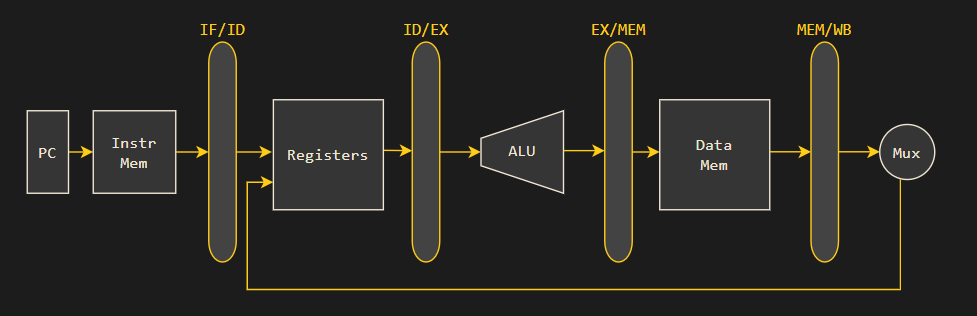 Figure 2: The same datapath with the major blocks per stage (PC + instruction memory in IF, register file + control in ID, ALU in EX, data memory in MEM, writeback mux in WB).
These two figures are the conceptual reference. The Pipeline Stages page replaces the boxes with the actual SystemVerilog: the PC-mux priority order, the instruction-field decode, the ALU source multiplexers, the forwarding paths into EX, the byte-enable generation for sub-word loads and stores, and the writeback mux.
What the core does and doesn’t do
riscv-5i implements the RV32I base integer ISA: arithmetic, logical, shifts, comparisons, loads and stores (including the byte and half-word variants with sign- or zero-extension), unconditional branches (JAL, JALR), and the six conditional branches (BEQ, BNE, BLT, BGE, BLTU, BGEU). LUI and AUIPC route through the ALU using small tricks documented on the Stages page.
It does not implement the M extension (no hardware multiply or divide), any CSRs (the SYSTEM and FENCE opcodes both decode as NOPs in src/control_unit.sv), any cache, or exception or interrupt handling. Test completion is signaled by a memory-mapped tohost address at 0x8000_1000 that the simulation harness watches; on the FPGA, the 4-bit memory-mapped LED register at 0x8000_0000 is the only I/O.
References
- Patterson, D. A. & Hennessy, J. L. Computer Organization and Design: The Hardware/Software Interface (RISC-V Edition). Morgan Kaufmann, 2017.
- Chapter 4: the processor and the 5-stage pipeline
- Section 4.6: pipelined datapath and control
- Section 4.7: data hazards and forwarding
- Section 4.8: control hazards
- RISC-V International. The RISC-V Instruction Set Manual, Volume I: Unprivileged ISA (v20191213).
- Section 2: RV32I base integer instruction set
- Section 2.5: control transfer instructions
- Section 2.6: load and store instructions
- RISC-V software tools:
riscv64-unknown-elf-gcc(cross-compiler) andspike(golden simulator used by RISCOF).